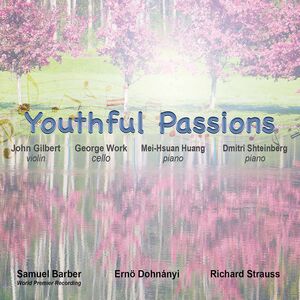
The six sonatas featured in this recording are neo-Romantic pieces by composers who lived well into the twentieth century. Almost all are youthful works by composers in the first flowering of their careers. Both the Strauss cello and the Barber violin sonatas were begun with the composers were still in their teens, and most of the others are the work of composers in their twenties. The sole exception is Dohnanyi's violin sonata, which was completed with the composer was in his thirties. This is the world premiere recording of the corrected version of the Samuel Barber Sonata for Violin and Piano- sections of the third movement were originally published and recorded in the wrong order.
1 Sonata in F minor for Violin and Piano, Op. 4. Allegro agitato (third movement from Sonata)
2 Sonata in C minor, Op. 6 for Cello and Piano~I. Allegro ma non troppo
3 Sonata in C minor, Op. 6 for Cello and Piano~II. Adagio
4 Sonata in C minor, Op. 6 for Cello and Piano~III. Allegro appassionato
5 Sonata in C# minor, Op. 21 for Violin and Piano~I. Allegro appassionato
6 Sonata in C# minor, Op. 21 for Violin and Piano~II. Allegro ma con tenerezza
7 Sonata in C# minor, Op. 21 for Violin and Piano~III. Vivace assai
8 Sonata in Bb minor, Op. 8 for Cello and Piano~I. Allegro ma non troppo
9 Sonata in Bb minor, Op. 8 for Cello and Piano~II. Scherzo. Vivace assai
10 Sonata in Bb minor, Op. 8 for Cello and Piano~III. Adagio non troppo - Tema con variazione (Allegro moderato)
- Disc 2 -
1 Sonata in Eb major, Op. 18 for Violin and Piano~I. Allegro ma non troppo
2 Sonata in Eb major, Op. 18 for Violin and Piano~II. Improvisation. Andante cantabile
3 Sonata in Eb major, Op. 18 for Violin and Piano~III. Finale. Andante - Allegro
4 Sonata in F major, Op. 6 for Cello and Piano~I. Allegro con brio
5 Sonata in F major, Op. 6 for Cello and Piano~II. Andante ma non troppo
6 Sonata in F major, Op. 6 for Cello and Piano~III. Finale. Allegro vivo
The six sonatas featured in this recording are neo-Romantic pieces by composers who lived well into the twentieth century. Almost all are youthful works by composers in the first flowering of their careers. Both the Strauss cello and the Barber violin sonatas were begun with the composers were still in their teens, and most of the others are the work of composers in their twenties. The sole exception is Dohnanyi's violin sonata, which was completed with the composer was in his thirties. This is the world premiere recording of the corrected version of the Samuel Barber Sonata for Violin and Piano- sections of the third movement were originally published and recorded in the wrong order.