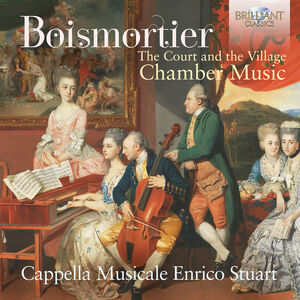
Boismortier (1689-1755) was a highly successful composer, active at the same time as Jean-Louis Rameau (1683-1764) during the Rococo era and the reign of Louis XV. He wrote over 100 compositions during his lifetime, and their characteristic lightness and grace made him immensely popular with Parisian sophisticates of his day. This set opens with an upbeat and charming trio sonata (Op.37/3) in which the recorder flits between playful and sombre melody lines with ensemble accompaniment. Boismortier is most known for his compositions for the recorder and the flute, but he composed for a wide variety of instruments. For example, this release includes two suite movements from his Pieces de clavecin Op.59 for solo harpsichord. 'La Puce' (The Flea) has a humorous staccato theme which jumps along the keyboard before evolving into a satisfying harmonic progression. Boismortier's music is a blend of Italian and French styles, and he was the first French composer to employ the Italian concerto style, of which this set contains two examples. An entrepreneur in the modern sense, Boismortier had no patrons and published his own music, a rare feat for the time. The composer earned enough from sales to be self-sufficient, meaning he could freely pursue the latest musical trends without having to conform to the tastes of commissioning aristocrats. Boismortier studied with the accomplished motetist Joseph Valette de Montigny (1665-1738), and he lived in Perpignan for several years working as a receiver for the Royal Tobacco Control before making a name for himself as a composer. Word of his sublime and effortless music soon reached Paris, and not long after, in 1724, he moved to the French capital, where he continued composing until his death. The set closes with rousing folk music in the fourth 'village dance' suite from his 4 Balets de village en trio Op.52. The rustic melodies contrast with an arrangement typically favoured by the elites: Boismortier employs flutes, recorders, violin and a steady basso continuo. This is perhaps a reflection on dual identity, by a composer who climbed the economic ladder from a humble upbringing in Thionville to join the ranks of Parisian high society.
4 Concerto à cinq parties in E minor Op. 37 No. 6~I. Allegro
5 Concerto à cinq parties in E minor Op. 37 No. 6~II. Adagio
6 Concerto à cinq parties in E minor Op. 37 No. 6~III. Allegro
7 Concerto in D Op. 38 No. 1~I. Allegro
8 Concerto in D Op. 38 No. 1~II. Allegro
9 Concerto in D Op. 38 No. 1~III. Adagio
10 Concerto in D Op. 38 No. 1~IV. Allegro
11 Cinquième Suite in E (from Diverses pièces Op. 31)~I. Prélude
12 Cinquième Suite in E (from Diverses pièces Op. 31)~II. Allemande
13 Cinquième Suite in E (from Diverses pièces Op. 31)~III. Air
14 Cinquième Suite in E (from Diverses pièces Op. 31)~IV. Gavotte en Rondeau
15 Cinquième Suite in E (from Diverses pièces Op. 31)~V. Menuet
16 Troisième Suite in E minor (from Pièces de clavecin Op. 59)~II. Pièce en rondeau 'La Puce'
17 Sonata à 4 in E minor Op. 34 No. 3~I. Andante
18 Sonata à 4 in E minor Op. 34 No. 3~II. Presto
19 Sonata à 4 in E minor Op. 34 No. 3~III. Adagio
20 Sonata à 4 in E minor Op. 34 No. 3~IV. Allegro
21 Deuxième Suite in E minor (from 6 Suites à 2 muzettes Op. 17)~I. Prélude
22 Deuxième Suite in E minor (from 6 Suites à 2 muzettes Op. 17)~II. Gigue
23 Deuxième Suite in E minor (from 6 Suites à 2 muzettes Op. 17)~III. Rondeau I/II
24 Deuxième Suite in E minor (from 6 Suites à 2 muzettes Op. 17)~IV. Branle
25 Deuxième Suite in E minor (from 6 Suites à 2 muzettes Op. 17)~V. Rigaudon I/II
26 Deuxième Suite in D minor (from Pièces de clavecin Op. 59)~III. Pièce en rondeau 'La Rustique'
27 Concerto in E minor Op. 38 No. 2~I. Allegro
28 Concerto in E minor Op. 38 No. 2~II. Largo
29 Concerto in E minor Op. 38 No. 2~III. Allegro
30 Quatrième Balet in G (from 4 Balets de village en trio Op. 52)~I. Rondement - II. Gaiment - III. Légèrement
31 Quatrième Balet in G (from 4 Balets de village en trio Op. 52)~IV. Doucement - V. Mouvement de chaconne
Boismortier (1689-1755) was a highly successful composer, active at the same time as Jean-Louis Rameau (1683-1764) during the Rococo era and the reign of Louis XV. He wrote over 100 compositions during his lifetime, and their characteristic lightness and grace made him immensely popular with Parisian sophisticates of his day. This set opens with an upbeat and charming trio sonata (Op.37/3) in which the recorder flits between playful and sombre melody lines with ensemble accompaniment. Boismortier is most known for his compositions for the recorder and the flute, but he composed for a wide variety of instruments. For example, this release includes two suite movements from his Pieces de clavecin Op.59 for solo harpsichord. 'La Puce' (The Flea) has a humorous staccato theme which jumps along the keyboard before evolving into a satisfying harmonic progression. Boismortier's music is a blend of Italian and French styles, and he was the first French composer to employ the Italian concerto style, of which this set contains two examples. An entrepreneur in the modern sense, Boismortier had no patrons and published his own music, a rare feat for the time. The composer earned enough from sales to be self-sufficient, meaning he could freely pursue the latest musical trends without having to conform to the tastes of commissioning aristocrats. Boismortier studied with the accomplished motetist Joseph Valette de Montigny (1665-1738), and he lived in Perpignan for several years working as a receiver for the Royal Tobacco Control before making a name for himself as a composer. Word of his sublime and effortless music soon reached Paris, and not long after, in 1724, he moved to the French capital, where he continued composing until his death. The set closes with rousing folk music in the fourth 'village dance' suite from his 4 Balets de village en trio Op.52. The rustic melodies contrast with an arrangement typically favoured by the elites: Boismortier employs flutes, recorders, violin and a steady basso continuo. This is perhaps a reflection on dual identity, by a composer who climbed the economic ladder from a humble upbringing in Thionville to join the ranks of Parisian high society.