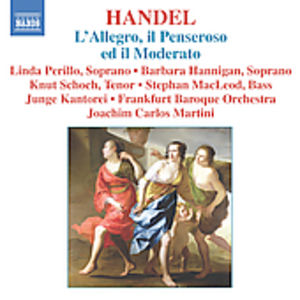
Composed in 1740, L'Allegro, il Penseroso, ed il Moderato is Handel's setting of poetry by John Milton, with additional verses (in the third part of three) by Charles Jennens. This oratorio is a kind of moderated dialogue between two personalities - the merry and carefree, and the thoughtful and ruminative. Jennens added "il Moderato" - the moderate man who balances the other two types. It seems not to have been Handel's intention to instruct listeners as to the most favorable type. Instead, he must have been most attracted by Milton's poetry, and by the opportunity to compose the sort of pastoral entertainment which he had found so congenial in earlier compositions. Sometimes the third part, entirely set to verses by Jennens, is dropped. This was the case even in Handel's time; it was felt that Jennens could not hold a candle to Milton. Some of the work's first recordings (for example, a 1960 version conducted by Sir David Willcocks) do the same, and also rearrange the remaining movements. This new version is given complete, however.
1 A Tempo Giusto/Allegro/Adagio - Joachim Carlos Martini
2 Hence, Loathed Meloncholy - Knut Schoch
3 Henc, Vain Deluding Joys - Linda Perillo
4 Come, Thou Goddess Fair and Free - Barbara Hannigan
5 Come Rather, Goddes, Sage and Holy - Linda Perillo
6 Haste Thee, Nymph - Chorus
7 Come and Trip It - Chorus
8 Come, Pensive Nun - Linda Perillo
9 Come, But Keep Thy Wonted State - Linda Perillo
10 There, Held in Holy Passion Still/Join with Thee - Chorus
11 Hence, Loathed Melancholy - Knut Schoch
12 Mirth, Admit Me of Thy Crew - Barbara Hannigan
13 First and Chief, on Golden Wing - Linda Perillo
14 Sweet Bird - Linda Perillo
15 If I Give Thee Hounour Due - Stephan MacLeod
16 Mirth, Admit Me of Thy Crew - Stephan MacLeod
17 Oft, on a Plat of Rising Ground - Linda Perillo
18 Far from All Resort of Mirth - Linda Perillo
19 If I Give Thee Honour Due - Knut Schoch
20 Let Me Wander Not Unseen - Knut Schoch
21 Straight Mine Eye - Barbara Hannigan
22 Mountains, on Whose Barren Breast - Stephan MacLeod
23 Or Let the Merry Bells Ring Around/And Young and Old Come Forth to Play - Chorus
- Disc 2 -
1 Larghetto/Polonaise - Joachim Carlos Martini
2 Hence, Vain Deluding Joys - Linda Perillo
3 Sometimes Let Gorgeous Tragedy - Linda Perillo
4 But Oh, Sad Virgin - Linda Perillo
5 Thus, Night, Oft See Me - Linda Perillo
6 Populous Cities Please Me Then - Chorus
7 There Let Hymen Oft Appear - Barbara Hannigan
8 Me, When the Sun Begins to Fling - Linda Perillo
9 Hide Me from Day's Garish Eye - Linda Perillo
10 I'll to the Well-Trod Stage Anon - Knut Schoch
11 And Ever Against Eating Cares - Barbara Hannigan
12 Orpheus Self May Have His Head - Barbara Hannigan
13 These Delights If Thou Canst Give - Chorus
14 But Let My Due Feet Never Fail - Linda Perillo
15 There Let the Pealing Organ Blow - Chorus
16 May at Last My Weary Age - Linda Perillo
17 These Pleasures, Meloncholy, Give - Chorus
18 Largetto/Fuga - Joachim Carlos Martini
19 Hence! Boast Not, Ye Profane - Stephan MacLeod
20 Come, with Native Lustre Shine - Stephan MacLeod
21 Sweet Temp'rance/Allthis Company - Chorus
22 Come, with Gentle Hand Restrain - Linda Perillo
23 No More Short Life They Then Will Spend in Straying - Knut Schoch
24 Each Action Will Derive New Grace - Knut Schoch
25 As Steals the Morn Upon the Night - Barbara Hannigan
26 Thy Pleasures, Moderation, Give - Chorus
Composed in 1740, L'Allegro, il Penseroso, ed il Moderato is Handel's setting of poetry by John Milton, with additional verses (in the third part of three) by Charles Jennens. This oratorio is a kind of moderated dialogue between two personalities - the merry and carefree, and the thoughtful and ruminative. Jennens added "il Moderato" - the moderate man who balances the other two types. It seems not to have been Handel's intention to instruct listeners as to the most favorable type. Instead, he must have been most attracted by Milton's poetry, and by the opportunity to compose the sort of pastoral entertainment which he had found so congenial in earlier compositions. Sometimes the third part, entirely set to verses by Jennens, is dropped. This was the case even in Handel's time; it was felt that Jennens could not hold a candle to Milton. Some of the work's first recordings (for example, a 1960 version conducted by Sir David Willcocks) do the same, and also rearrange the remaining movements. This new version is given complete, however.